Home

A History of Volumetric Imaging

Welcome to the world of Volumetric Imaging where we attempt
to create the practical "crystal ball" of the soothsayers
-- a volume in which all space and time may be displayed at your command.

The Early Pioneers

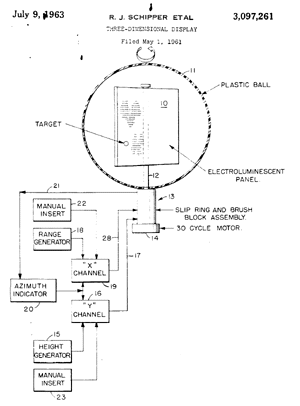
One of the earliest functional volumetric imagers was this excellent design by Schipper from 1960. It set the standard for the rotating screen technologies which were to follow -- including x-y addressing, a speed control motor, and a stationary enclosure.

At the time, high speed light emitters were extremely costly serious hindering the development of large prototype systems for the study of the human visual system response.


Ketchpel Patent

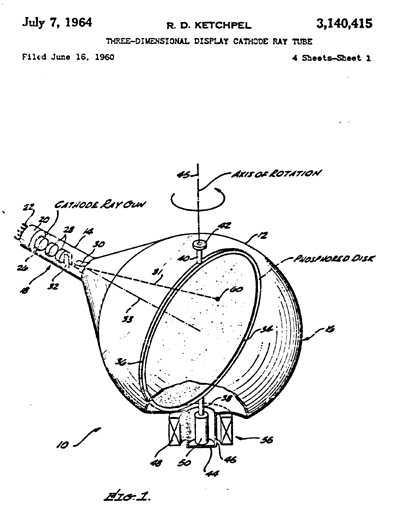
Ketchpel's 1960 Cathode Ray Tube Imager represents a major step in the integration of television technology and volumetric imaging. Although the electron beam steering technology was at its infancy he clearly anticipated systems which would embody complex, computer-controlled single and multiple guns within an evacuated enclosure.

  A Move To Lasers

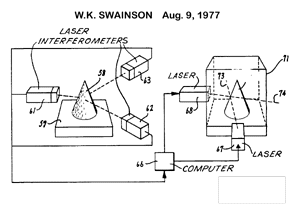
The Swainson Laser Imager in the mid 1970's represents a conceptual breakthrough in volumetric systems. For the first time, the concept of a volume comprised of a homogeneous media and illuminated by intersecting beams was proposed. Swainson enumerated a broad spectrum of excitable composites.

Swainson Patent


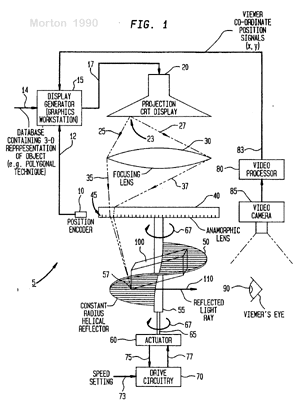
In 1990, Eastman Kodak researcher, E.L. Morton, devised a method for eliminating the defocusing effect of the change in optical path length in the helical screen volumetric imagers.

Simple & Practical Technology

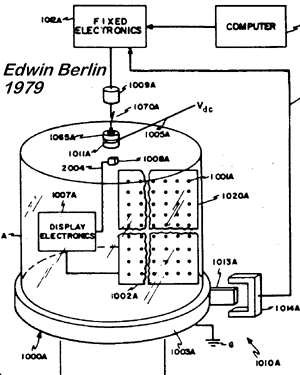
As a student at MIT in the late 1970's, Edwin Berlin developed a innovative approach to data flow problem which had been constraining early systems. He placed the display electronics on a rotating matrix of light emitters and used a high-speed optical link to connect to the outside world.

The technology was exiled from MIT by myopic visionaries.

In 1990, Volumetric Imaging licensed the patent and developed a low cost system which displays 1,000,000 voxels simultaneously.

Projects

  The Volumetric Matrix HoloDeck Imager Model 200

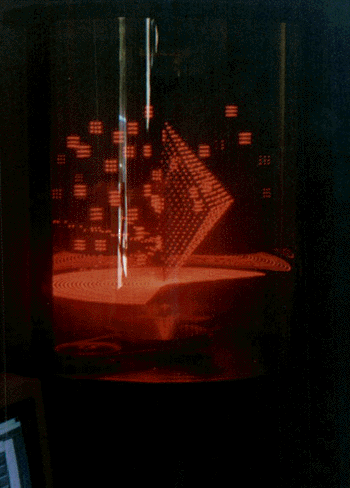
The Model 200 is a 18" diameter x 36" high Matrix Imager System. All the computational components are contained within the enclosure of aluminum and polycarbonate.

This Imager was designed for lower cost experimentation and demonstration. It found success as a research platform in academia and government as well as in the "high art world" when Jenny Holzer chose it as the centerpiece for her Siddeutchse Zeitung exhibit "Lustmord" in 1994. In addition to wide visibility in the European press, the Imager was included in a Sunday New York Times Art Section article on her exhibit.

This Model Imager has found a place at SIGGRAPH 1994, trade shows and symposia for general advertising purposes.

The Volumetric Matrix HoloDeck Imager integrated our patented "out of the sphere" technology.

  HoloDeck™ is a trademark of the  SG Group

Other VI systems